Ecosystem grants.
The program that will fund work on the protocol, five tracks, published criteria, tiered review, every award logged in a public registry. Status: launching. The design is drafted and published so builders can prepare. No grants have been awarded yet.
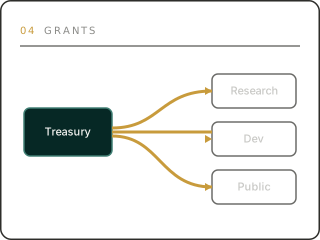
Not yet operating. The program begins when the Foundation does, and the Foundation is in pre-formation (a Mauritius foundation is the intended vehicle, subject to counsel). Until launch there is no application portal, no committee, and no award. Anyone claiming to award Adunai grants today is not us.
What the program will fund
Work that advances open, non-state digital public infrastructure for African economic life, the identity, payments, attestations, savings, and reputation primitives described in the whitepaper. The budget is allocated from the Foundation Treasury under Charter Article VI. The Year-1 target is $500K–$1Mscaling with Treasury growth, a target, not a commitment; it firms up when the Foundation's Treasury does.
Grants are transactional. Recipients deliver what they committed to and keep ownership of their work. No equity, no tokens, no ongoing obligation to the Foundation. Attribution is expected; control is not.
Five tracks
| Track | What it funds | Typical size |
|---|---|---|
| Research | Work that informs protocol design, economic modeling, security analysis, user research on African wallet patterns, legal and regulatory analysis by jurisdiction. Deliverable: published research, open methodology. | $10K–$100K |
| Development | Technical work that strengthens the protocol or makes it easier to build on, SDKs in languages beyond the core TypeScript SDKindexers, developer tooling, reference integrations. Deliverable: working open-source code with a maintenance commitment. | $25K–$500K |
| Ecosystem | Applications built on Adunai that reach real users, consumer wallets beyond the reference implementation, remittance and payroll products, integrations into existing African fintech. Deliverable: shipped product, reported usage. | $50K–$500K |
| Community | Education, documentation, events, translation, developer docs in French, Portuguese, Arabic, Swahili; tutorials; regional hackathons; university curriculum. Deliverable: published content, documented reach. | $5K–$50K |
| Public goods | Infrastructure that benefits the broader ecosystem, not Adunai specifically, maintenance of open-source dependencies, general security tooling, open datasets for African fintech research. | $10K–$100K |
The draft also defines two specialized infrastructure tracks. Attestation & verification infrastructure ($25K–$250K) will fund the Layer 2 attestation issuers and Layer 3 institutional verifiers the trust model depends on, the protocol provides the primitive; the ecosystem provides the trust. A grant funds the development work only; authorization to mint institutional handles is a separate governance act under the Charter. Layer C relay infrastructure ($15K–$200K) phases with Layer C itself, which is Phase 2+ architecture: specification research first, prototype implementations next, operator subsidies last.
How decisions will be made
No one picks winners. Applications are scored against five published criteria, alignment, quality, impact, cost-effectiveness, and applicant track record, each 0–5. A total of 15/25 or better is competitive; below 12 is typically rejected; 12–15 draws close scrutiny and usually a revision request. Review depth scales with size:
- Under $25K: Executive Director approval, rolling submissions reviewed monthly, decision within two weeks.
- $25K–$250K: Grants Committee by majority vote, applicant interview required, decision within four weeks.
- Over $250K: full Board review, a formal Technical Advisory Council recommendation, and a two-week public comment period before the decision.
Reviewers sign conflict disclosures and recuse where a personal, family, or business relationship exists; recusals are documented in the review record. Foundation directors, officers, and staff are ineligible to apply at all.
Every award is logged: a public registry will list each grant's ID, recipient, amount, track, purpose, status, and deliverables, with an annual report on totals by track and region and 12-month post-completion outcome updates. Rejected applications are not publicized, applicants receive substantive written feedback instead.
Payments will be milestone-based (medium grants: 30% upfront, 40% at mid-milestone, 30% on completion) and disbursed over the protocol's own rails, in USDC or the recipient's preferred stablecoin. The distribution contract, GrantDistributoris already live on Base Sepolia, testnet, pre-audit; a single external audit of the complete v1 system gates mainnet.
Neutrality rules
- Criteria decide, not connections. Applications are evaluated on stated criteria, not on who the applicant knows or represents.
- No equity in any builder. The Foundation funds what builds on the protocol; it takes no stake in the builders. Grants convey deliverable obligations and nothing else.
- No favored products. The Foundation stewards reference implementations, aID, the reference identity client behind Sign in with Adunaiand a public reference-wallet design preview (a forkable wallet scaffold is held open for Phase 1+), so that no builder starts from zero. They are references, not competitors.
- Public goods bias. Where quality is similar, preference goes to open-source over proprietary and shared infrastructure over siloed tools.
- African context, preferentially. Work by African builders serving African use cases is preferred, not required. Global contributors are welcome.
What the program is not: a replacement for venture investment (grants fund work; investors fund companies), a token-incentive scheme (the Foundation does not issue tokens), a marketing budget, or an implied ongoing relationship.
How to prepare
Applications will be open to individuals, companies, academic institutions, and government-adjacent research bodies. Anonymous applications will not be accepted, accountability requires an identifiable applicant, though a pseudonym is acceptable if identity is disclosed confidentially to the Foundation. Submissions will go through a dedicated portal only, so every application carries an audit trail; the portal address publishes at launch. Small grants will review on a rolling monthly basis; larger grants batch quarterly.
A proposal will need:
- Applicant identification, name and background, or organization details
- Proposed work, what you will build, produce, or research
- Timeline, milestones and expected delivery dates
- Budget, requested amount, breakdown, justification
- Deliverables, what you hand back to the Foundation and community
- Success metrics, how we will know it worked
- Team and credentials, who does the work, and their relevant experience
- Conflicts of interest, any relationship with the Foundation or related entities
- IP and licensing, typically Apache-2.0 or MIT for code, CC-BY for content
The strongest preparation is a track record against the live testnet. All 35 contracts are on Base Sepolia today; the TypeScript SDK is in the repository under Apache-2.0 (npm publication lands with the Phase 1 public release). Check current status before scoping a proposal, what is live, what is dormant, and what is gated on the audit are all stated there. For what the protocol is and why, start at the overview.