Roadmap · progressive decentralization.
Adunai is built as patient generational infrastructure, optimized for ten-plus-year durability, not eighteen-month velocity. This page states plainly where the protocol is today, what each phase adds, and how the Foundation's authority is scheduled to decrease under Charter Article XI. No calendar dates beyond ratified month-ranges; no claims beyond what is on chain.
Where we are · Phase 0
The complete v1 system, 35 contracts: has been live on Base Sepolia testnet since 2026·07·01, deployed in a single broadcast, 34 of 35 source-verified on Basescan. See the contract registry for every address and status for the live picture. The system is pre-audit: a single external audit of the complete v1 system gates mainnet, and mainnet addresses publish after audit close, never before it. Details on security & audit.
Honest markers of the current state:
- Testnet only. No real money moves through the protocol. No real users, no real volume, pilot transactions on testnet are exactly that.
- Payment routing dormant. ProtocolConfig's five-token launch whitelist (USDC · USDT · EURC · cbBTC · WETH) is live; PaymentsRouter's routing whitelist arms through the 14-day timelock as a governance action. The 0.1% protocol fee applies when routing arms.
- Foundation in pre-formation. Mauritius is the intended jurisdiction, subject to counsel. The Charterthirteen articles, is drafted and published; it enters effect at incorporation (Article XIII).
- SDK in-repo, not on npm.
@adunai/sdkis Apache-2.0 in the protocol repository today; the npm release lands with the Phase 1 public testnet. - Grants launching, not operating. The GrantDistributor contract is live on testnet; no awards have been made.
- Bug bounty scales in Phase 1.
The phase ladder
Windows are ratified month-ranges, not calendar commitments. Each phase gates the next; none is skipped for speed.
| Phase | Window | Ratified scope |
|---|---|---|
| 0 · now | now – Month 6 | Protocol foundation: 35 contracts live on Base Sepolia; aID reference identity-client baseline; SDK first usable version; cross-border SMB demo dApp; marketing site v1; first SMB pilot transaction on testnet. |
| 1 | Month 6 – 12 | Wallet privacy primitives added to the existing MVP, stealth addresses per EIP-5564, per-counterparty DID rotation, selective disclosure. Public testnet opens; SDK first public release (npm); bug bounty scaled; smart-contract lead onboarded; seed closed. |
| 2 | Month 12 – 18 | The single external audit of the complete v1 system; controlled mainnet launch, post-audit, never before; off-chain rails (mobile-money bridges, the agent network); first real users. |
| 3 | Month 18 – 30 | Local-currency stablecoin readiness, cXAF, cNGN, cKES, each designed to be backed 1:1 by its own central bank's reserves (the Foundation issues no currency; see the whitepaper); multi-chain expansion; ecosystem grants at scale. |
| 4+ | Years 3 – 5+ | Long-term decentralization; continental scale; Foundation hand-off to community governance under Article XI. |
Governance today
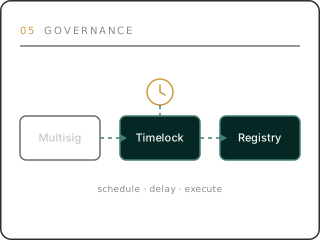
Until authority devolves, every protocol upgrade follows one path: a public RFC with a 14-day comment period → Technical Advisory Council review → approval by 5-of-9 of the nine-signer multi-sig, three Foundation directors, three technical advisors from the Technical Advisory Council, three ecosystem representatives nominated by the Community Advisory Council, → a 14-day on-chain timelock before execution. A bounded emergency pause exists (Charter §4.3): 7-of-9 with documented rationale, lasting no more than 14 days unless community ratification extends it. Emergency security patches may bypass the RFC comment period; they may never bypass the timelock.
On-chain voting is not live today. It is the scheduled direction, delegated voting for non-critical parameters arrives in Year 3 of the Article XI schedule below.
Article XI · what devolves when
Charter Article XI commits the Foundation to progressive decentralization: authority decreases over time as community governance takes over. The schedule runs from charter effect, incorporation of the Foundation. Since the Foundation is pre-formation, the Year-1 clock has not started.
| Year | Authority transferred |
|---|---|
| 1 | Foundation operates with full governance authority. Community input through the three advisory councils, Technical, Regulatory, Community (non-governing). |
| 2 | Community proposal mechanism launches. The Foundation retains execution authority; the community can formally propose. |
| 3 | Delegated voting for non-critical parameters. Fee adjustments and grant allocations transition to community vote with Foundation review. |
| 4 | On-chain governance for protocol upgrades. The Foundation retains emergency pause authority only. |
| 5 | Foundation role reduces to trademark stewardship, regulatory engagement, legal-entity continuity. All protocol governance on-chain. |
| 7+ | The Foundation optionally sunsets into a community-governed equivalent, or continues as a minimal legal entity. |
Two provisions make this schedule credible rather than aspirational. Non-reversal (§11.4): once authority transfers to the community, the transfer is permanent, the Foundation may not take it back. Non-amendability (Article XII.2): the decentralization commitment cannot be amended out of the Charter except by dissolution and re-chartering. Progress is measured and reported annually, active governance participants, voting participation, the proportion of decisions made on-chain, and the Foundation's decreasing treasury share.
What gates what
The audit gates mainnet. The system is testnet, pre-audit. A single external audit of the complete v1 system stands between Base Sepolia and any mainnet address. Phase windows are month-ranges ratified in planning documents, not dates, infrastructure meant to last decades does not publish deadlines it would be tempted to keep at the cost of correctness.
One neutrality note, because decentralization is only credible from a neutral steward: the Foundation holds no equity, tokens, or financial stake in any commercial builder on the protocol. No one picks winners. The reference implementation, aIDexists so that every builder starts from the same open baseline; a reference wallet is held open for Phase 1+, with a design preview public today.