Settlement & payments.
How value moves on Adunai, whitelisted ERC-20 routing, signed settlement rates, savings primitives, and the agent settlement economy, on Base. Settlement is the first application of the identity substrate, not its center.
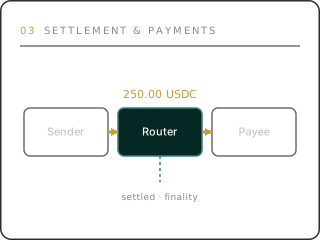
Payments are downstream of identity
Adunai's architectural heart is identity, DIDs, attestations, recovery, reputation. Most of the contract surface is identity-side, and the payment contracts are consumers of it: PaymentsRouter resolves human-readable handles before it moves a token, agent settlement keys on DIDs rather than raw addresses, and savings beneficiaries resolve through the recovery substrate. This is the composition order of the systems Adunai takes as peers, a payment rail built on an identity layer, not an identity feature bolted onto a payments product. The whitepaper §6 sets out the economic design in full.
PaymentsRouter · the routing rail
PaymentsRouter routes any whitelisted ERC-20 between Adunai identities, taking a 0.1% protocol fee on volume that flows to the Treasury. Recipients can be addressed by handle, @aminatanot a hex string, resolved on-chain at send time. Fees are visible and queryable before a transfer is submitted; there is no hidden spread.
The routing rail is dormant. PaymentsRouter is deployed and source-verified on Base Sepolia, but its own routing whitelist is empty. Arming it, addTokenis held by the TimelockController and carries a 14-day delay. Until that governance action executes, nothing routes. This is deliberate: the rail opens by visible governance, not by default.
The launch whitelist · ProtocolConfig
ProtocolConfig, the token whitelist and per-token economic configuration, is live, seeded with five assets at initialization, each with a per-token minimum fee and fee cap in its own native units:
| Asset | Role |
|---|---|
USDC | Primary stablecoin, cross-border SMB, remittance, savings. |
USDT | Secondary stablecoin, coverage where USDC is not present. |
EURC | EUR-denominated, European corridors, CFA-zone relevance. |
cbBTC | BTC-denominated, conservative savings primitive on Base. |
WETH | Native L2 asset, gas and savings. |
The Foundation issues none of these. External stablecoins are integrated as first-class assets, never issued. Whitelist changes pass the full governance path: an RFC with a 14-day public comment window, Technical Advisory Council review, 5-of-9 approval of the nine-signer multi-sig, directors, technical advisors, and ecosystem representatives, then the 14-day timelock. See the charter.
Settlement rates · RateOracle and SignerRegistry
Cross-currency settlement needs exchange rates, and Adunai takes no external oracle dependency, no Chainlink, no Pyth. Rates are a Foundation-attested substrate verified on-chain: signers submit EIP-712 typed rate attestations, and RateOracle accepts an update only when it carries a threshold of distinct, authorized signatures. The signer set and threshold live in SignerRegistry, governed through the timelock.
| Tier | Cadence | Examples |
|---|---|---|
| Fixed | Set by governance, never attested | Treaty pegs, XAF/EUR at its 655.957 parity, KMF/EUR, CVE/EUR |
| Daily signed | One attestation per day | Low-volatility pairs, EURC/USDC, XAF/USDC (derived) |
| Hourly signed | One attestation per hour | NGN/USDC, KES/USDC, GHS/USDC, ZAR/USDC |
Consumers read two ways: display surfaces, the reference-wallet design preview among them, read getRate directly, while settlement-bound contracts pass the attestation itself as calldata to verifyAttestation and apply their own freshness policy. Registering the production signer set belongs to the same timelock-governed arming sequence that opens the routing rail.
Treasury
The Treasury is the protocol's fee accumulator: router fees, handle registration and renewal fees, and the Foundation's share of slashed agent collateral from dispute resolution. Its planned allocation, operations, ecosystem grants, reserve, agent-network incentives, is itself governed and can change. The grants program it will fund is launching; no awards have been made. On testnet, nothing real accumulates.
Savings primitives
SavingsRegistry · solo
Individual time-locked and goal savings: deposit, lock for a chosen period, withdraw at maturity. Early withdrawal carries a penalty that routes to the Treasury. A designated beneficiary can claim in full, no penalty, but only after AbandonmentRegistry's 60-day timelocked claim has run, vetoable throughout by the current key or registered guardians. There is no protocol-layer yielddeliberately: the protocol holds deposits, it does not invest them.
GroupSavings · rotating payout
The on-chain form of the continent's most widely practiced savings institution, chamasusunjangistokvelesusu. Members contribute each cycle; the pool pays out to one member in rotation; default policies and pro-rata dissolution refunds are set by the group's own configuration. The pool sits in the contract, never with the Foundation.
The agent settlement economy
Cash-in and cash-out is where on-chain value meets street-level reality, and it has its own contract family: AgentRegistry for registration, staking, and the supervised cash-in / cash-out surface; AgentSettlement as the settlement keystone; AgentSettlementForwarder for gasless settlement under signed fee bounds, so an agent's customer needs no ETH; AgentLiquidityPool and AgentSwapEscrow for agent-side liquidity; ComplaintRegistry for disputes anchored to settlements. Addresses and responsibilities are in the contract registry.
What is live, what is not
- 35 contracts live on Base Sepolia testnet since 2026·07·01; 34 of 35 source-verified. Current state on the status page.
- Pre-audit. A single external audit of the complete v1 system gates mainnet, mainnet addresses publish after it, never before. See security.
- Routing dormant. ProtocolConfig's whitelist is live; PaymentsRouter's routing whitelist arms via the 14-day timelock.
- No real users, no real volume. Testnet only; no real money moves through anything yet.
@adunai/sdkis in-repo under Apache-2.0, not on npm, npm publication lands with the Phase 1 public release. See the SDK reference.- The Foundation is in pre-formation (Mauritius intended, subject to counsel). The bug bounty program is Phase 1+.
Next
- Contract registryevery address, every responsibility.
- Sign in with Adunaithe identity flow payments compose on.
- Reference-wallet design previewhow these surfaces read to a person.